235. Lowest Common Ancestor of a Binary Search Tree
题目
Given a binary search tree (BST), find the lowest common ancestor (LCA) node of two given nodes in the BST.
According to the definition of LCA on Wikipedia: “The lowest common ancestor is defined between two nodes p and q as the lowest node in T that has both p and q as descendants (where we allow a node to be a descendant of itself).”
Example 1:
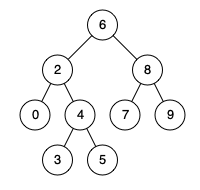
Input: root = [6,2,8,0,4,7,9,null,null,3,5], p = 2, q = 8
Output: 6
Explanation: The LCA of nodes 2 and 8 is 6.
Example 2:
Input: root = [6,2,8,0,4,7,9,null,null,3,5], p = 2, q = 4
Output: 2
Explanation: The LCA of nodes 2 and 4 is 2, since a node can be a descendant of itself according to the LCA definition.
Example 3:
Input: root = [2,1], p = 2, q = 1
Output: 2
Constraints:
- The number of nodes in the tree is in the range
[2, 105]. -109 <= Node.val <= 109- All
Node.valare unique. p != qpandqwill exist in the BST.
Related Topics
思路
BST 是可以根据所搜节点大小判断搜索方向,因为是自上而下的搜索,寻找在节点在 [p, q] 之间
超过范围时,可以分别进行left or right 的迭代
如果在范围内(注意此时是一个左右均闭合的集合) 则可以确定 lowset common ancestor 就是这个节点
递归解法
python
class Solution:
    def lowestCommonAncestor(self, root: 'TreeNode', p: 'TreeNode', q: 'TreeNode') -> 'TreeNode':
        l = min(p.val, q.val)
        r = max(p.val, q.val)

        if not root:
            return

        if l <= root.val <= r:
            return root
        elif root.val < l:
            return self.lowestCommonAncestor(root.right, p, q)
        else:
            return  self.lowestCommonAncestor(root.left, p, q)
简化后
python
class Solution:
    def lowestCommonAncestor(self, root: 'TreeNode', p: 'TreeNode', q: 'TreeNode') -> 'TreeNode':
        if root.val > q.val and root.val > p.val:
            return self.lowestCommonAncestor(root.right, p, q)

        elif root.val < q.val and root.val < p.val:
            return self.lowestCommonAncestor(root.left, p, q)

        return root
复杂度分析
- 时间复杂度 O(N)
- 极端情况下 tree 变成 linkedList 模式
- 空间复杂度 O(N)
迭代法
只需要找到目标范围的节点即可结束搜索,可以使用迭代法进行节点寻找,可将空间复杂度降低为1
py
# leetcode submit region begin(Prohibit modification and deletion)
# Definition for a binary tree node.
# class TreeNode:
#     def __init__(self, x):
#         self.val = x
#         self.left = None
#         self.right = None

class Solution:
    def lowestCommonAncestor(self, root: 'TreeNode', p: 'TreeNode', q: 'TreeNode') -> 'TreeNode':
        node = root

        while node:
            if node.val > p.val and node.val > q.val:
                node = node.left
            elif node.val < p.val and node.val < q.val:
                node = node.right
            else:
                return node

        return

# leetcode submit region end(Prohibit modification and deletion)
复杂度分析
- 时间复杂度 O(N)
- 空间复杂度 O(1)