124. Binary Tree Maximum Path Sum
题目
A path in a binary tree is a sequence of nodes where each pair of adjacent nodes in the sequence has an edge connecting them. A node can only appear in the sequence at most once. Note that the path does not need to pass through the root.
The path sum of a path is the sum of the node's values in the path.
Given the root of a binary tree, return the maximum path sum of any non-empty path.
Example 1:
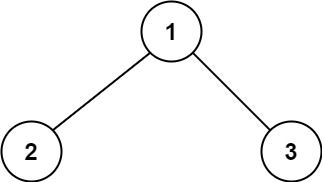
Input: root = [1,2,3]
Output: 6
Explanation: The optimal path is 2 -> 1 -> 3 with a path sum of 2 + 1 + 3 = 6.
Example 2:
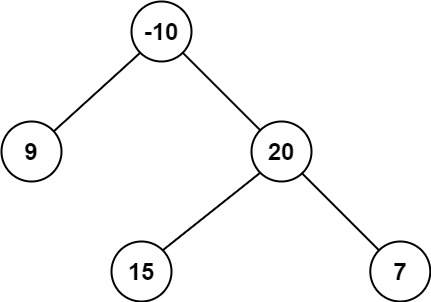
Input: root = [-10,9,20,null,null,15,7]
Output: 42
Explanation: The optimal path is 15 -> 20 -> 7 with a path sum of 15 + 20 + 7 = 42.
Constraints:
- The number of nodes in the tree is in the range
[1, 3 * 104]. -1000 <= Node.val <= 1000
Related Topics
思路
本题的思路是递归的返回值和更新结果的值不同
- 递归的返回值:
- 当前节点 + 最大的一颗子树路径
- 更新结果的值:
- 当前节点 + 非负所有子树
解法
py
# leetcode submit region begin(Prohibit modification and deletion)
# Definition for a binary tree node.
# class TreeNode:
#     def __init__(self, val=0, left=None, right=None):
#         self.val = val
#         self.left = left
#         self.right = right


class Solution:
    def maxPathSum(self, root: Optional[TreeNode]) -> int:
        self.res = -1001

        def dsf(root: Optional[TreeNode]) -> int:
            if not root:
                return 0

            left = max(0, dsf(root.left))
            right = max(0, dsf(root.right))


            self.res = max(self.res, left + right + root.val)

            return root.val + max(left, right)

        dsf(root)

        return self.res


# leetcode submit region end(Prohibit modification and deletion)
复杂度分析
- 时间复杂度 O(N)
- 空间复杂度 O(N)